
Publications
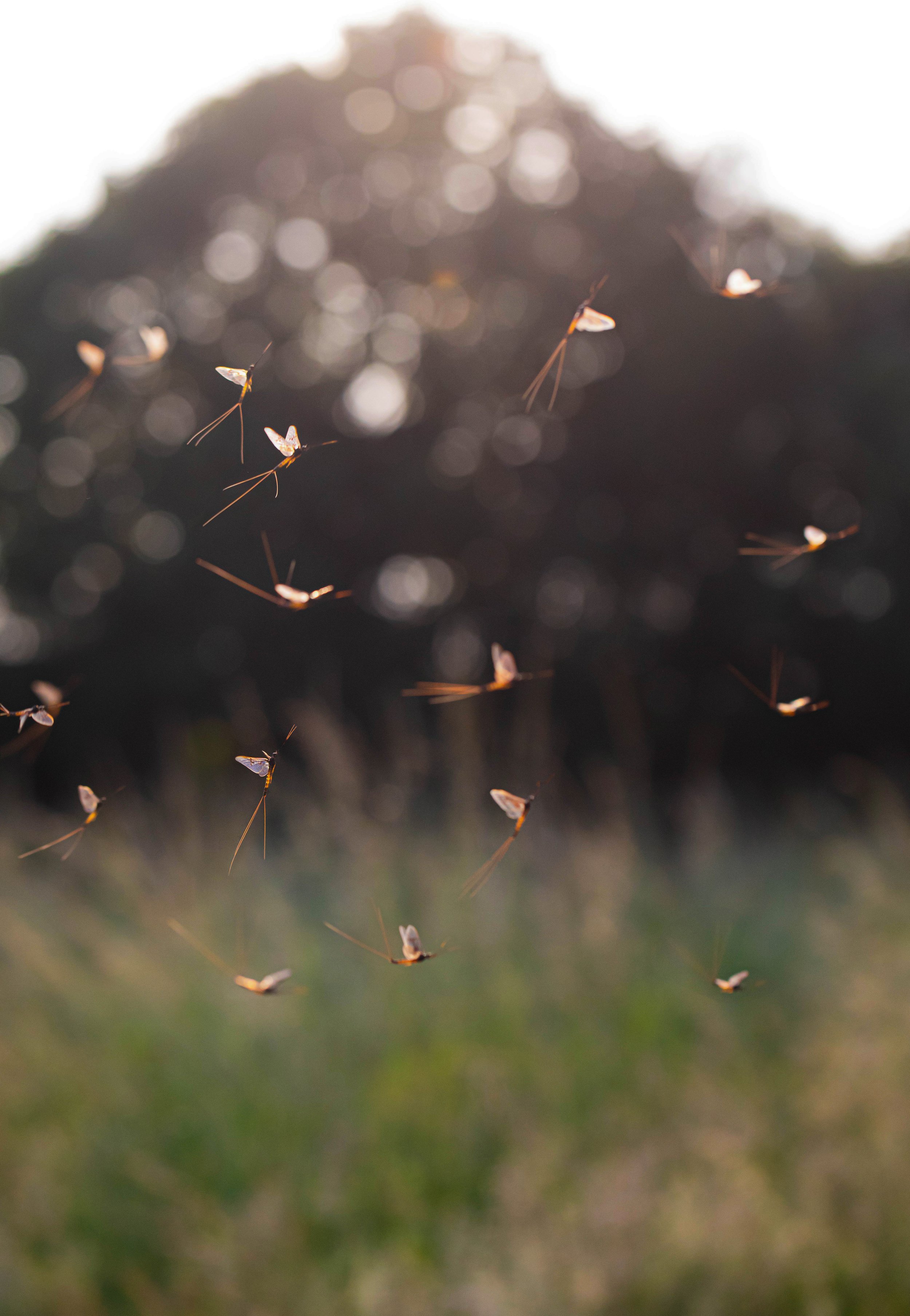
Male mayflies perform a dance to avoid being caught by other males
This work deals with the wonderfully weird flight patterns of male mayflies. From May - July, you can see these insects near bodies of water doing their characteristic 'dance' in which they fly vertically before passively parachuting back down. Our paper demonstrates that this flight patten helps the densely clustered males differentiate each other from females passing overhead. We also document how males detect, track, and intercept females, operating very much like miniature guided missiles. Unlike missiles, we find that mayflies deploy active air brakes to improve their manoeuvrability, the first animal described to do so.
Samuel T. Fabian, Benjamin P. Campbell, Eleanor F. Miller, Huai-Ti Lin; The nuptial dance of male mayflies helps avoid mistaken interception by other males. J Exp Biol 15 March 2026; 229 (6): jeb251579. doi: https://doi.org/10.1242/jeb.251579
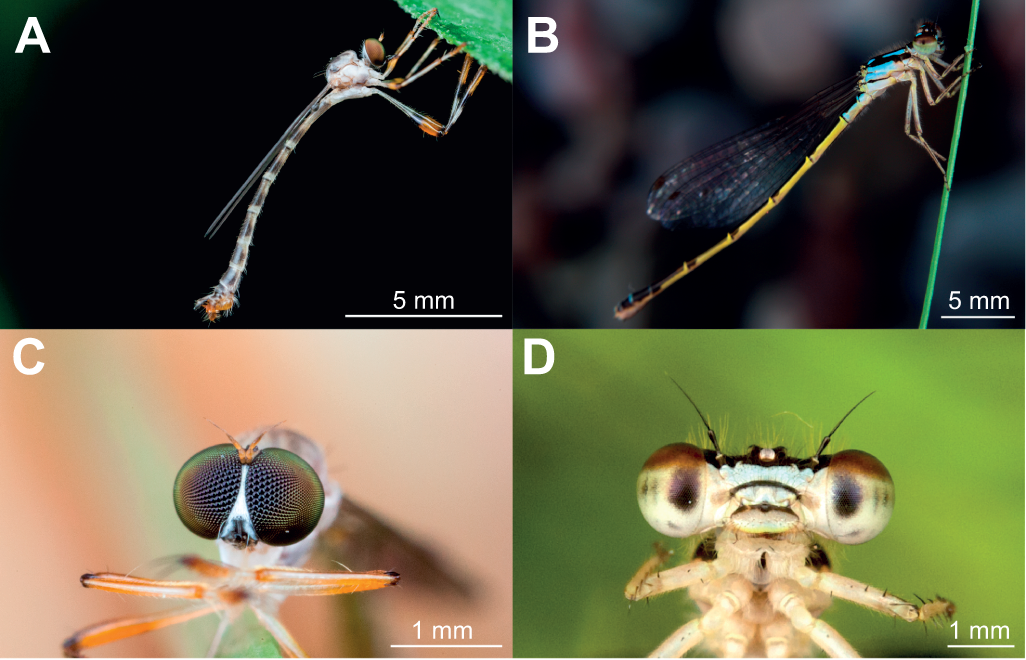
Different visual strategies for completing the same task
Pixie robberflies (Leptogastrinae) strongly resemble damselflies (Zygoptera) in both body and behaviour. Both insects grab prey from surfaces in a behaviour called gleaning. To do this, they must first identify prey, assess its suitability, and then guide a precision strike. This paper shows that the robberflies spend a long time weaving around the prey during the assessment, while damselflies do not. This is likely linked to the different eye designs of each group. The robberflies have a holoptic eye, effectively all one eye, which means they must use their own motion to assess depth (motion parallax). The damselflies widely separated eyes likely give it a direct measure of depth through stereopsis.
Sergio Rossoni, Mary E. Sumner, Doekele G. Stavenga, Samuel T. Fabian, Jack A. Supple, Paloma T. Gonzalez-Bellido; Predation via motion parallax in one of two gleaning insects. J Exp Biol 15 March 2026; 229 (6): jeb251710. doi: https://doi.org/10.1242/jeb.251710
Why do night-flying insects gather around artificial light?
It’s a question humans have asked for millennia, but without convincing answers. We used a mixture of field recordings, laboratory motion capture, and simulation to demonstrate that a single behavioural reflex traps insects around artificial light. This is the dorsal-light-response, which normally leads to level flight under a bright sky, but around a bright lamp, leads to disaster.
Fabian, S.T., Sondhi, Y., Allen, P.E. et al. Why flying insects gather at artificial light. Nat Commun 15, 689 (2024). https://doi.org/10.1038/s41467-024-44785-3

Obstacle avoidance during aerial interception
Our tiny robber-flies are capable of avoiding obstacles whilst flying toward their target. We demonstrate that the flies simultaneously process the motion of the target and the expansion of obstacles, flying a path that was intermediate between both tasks.
Samuel T. Fabian, Mary E. Sumner, Trevor J. Wardill, Paloma T. Gonzalez-Bellido; Avoiding obstacles while intercepting a moving target: a miniature fly's solution. J Exp Biol 15 February 2022; 225 (4): jeb243568. (doi: https://doi.org/10.1242/jeb.243568)

Steering limitations during high speed pursuit
It doesn't matter what an animal might want to do, physics limits their behaviour. We demonstrate that during high-speed pursuit, killerflies will push themselves to their limits, and sometimes beyond, causing them to miss their targets and crash.
Rossoni, S., Fabian, S. T., Sutton, G. P., & Gonzalez-Bellido, P. T. (2021). Gravity and active acceleration limit the ability of killer flies (Coenosia attenuata) to steer towards prey when attacking from above. Journal of the Royal Society Interface, 18(178), 20210058. (doi: 10.1098/rsif.2021.0058)

Passive Stabilising Reflexes in Dragonflies
Find out how dragonflies can automatically right themselves when upside down in the air, even when unconscious!
Fabian, ST, Zhou R, and Lin HT. 2021. Dragondrop: a novel passive mechanism for aerial righting in the dragonfly. Proceedings of the Royal Society B: Biological Sciences. 288 (1944). 20202676. (doi: 10.1098/rspb.2020.2676)

Missile Guidance in Predatory Flies
Two tiny predatory flies hunt using the same system as guided missiles to head toward the future position of the target. However, they tune this system differently to reflect their differing visual systems and hunting environment.
Fabian ST, Sumner ME, Wardill TJ, Rossoni S, Gonzalez-Bellido PT. 2018 Interception by two predatory fly species is explained by a proportional navigation feedback controller. J. R. Soc. Interface 15. (doi: 10.1098/rsif.2018.0466)

Diverse Behavioural Strategies from Ancient Predators:
Damselflies, unlike most dragonflies, use fused binocular information to encode the motion of targets. Find out how this is correlated to their head-on attack strategy and divergent hunting behaviour.
Supple JA, Pinto-Benito D, Khoo C, Wardill TJ, Fabian ST, Liu M, Pusdekar S, Galeano D, Pan J, Jiang S, Wang Y, Liu L, Peng H, Olberg RM, Gonzalez-Bellido PT. 2020. Binocular Encoding in the Damselfly Pre-motor Target Tracking System. Current Biology. 30 (4), 645-656. (doi: 10.1016/j.cub.2019.12.031)

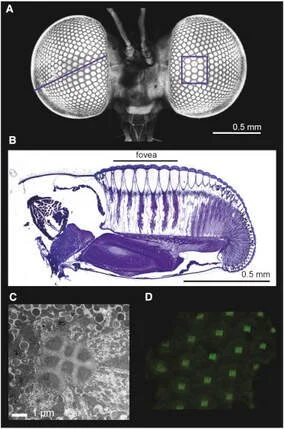
Exceptional Vision and Control in a Miniature Robber Fly
The tiny 'gnat ogre' robber fly uses extreme angular sensitivity over a narrow field of view in order to lock-on to targets from a great distance away. Find out about how these tiny flies have developed some of the sharpest compound eyes around.
Wardill TJ*, Fabian ST*, Pettigrew AC, Stavenga DG, Nordström K, Gonzalez-Bellido PT. 2017 A Novel Interception Strategy in a Miniature Robber Fly with Extreme Visual Acuity. Current Biology 27, 854–859. (doi: 10.1016/J.CUB.2017.01.050)
* Joint First Authorship
Guidance and Pursuit in Insects
Many insects use pursuit to catch a mate, dinner or both. Common adaptations and strategies abound in insects. Find out about these adaptations and how insects adapt to a making a living through chasing.
Gonzalez-Bellido PT, Fabian ST, Nordström K. 2016 Target detection in insects: optical, neural and behavioral optimizations. Curr. Opin. Neurobiol. 41, 122–128. (doi: 10.1016/j.conb.2016.09.001)
